Showing posts with label filter tip cigarettes. Show all posts

Sunday, October 25, 2015

How Air Holes Benefit Vapers But Leave Smokers Unsatisfied

Tobacco firms have been deceiving smokers for many years. Ads that have been promoting some tobacco products as "low-nicotine" or "low-tar" and with a "mild" or "light" flavor don't lie when they claim that their cigarettes produce little or no nicotine and tar in the smoke. However, they're not telling the whole truth either.


Tiny Holes in the Filter Will Push You to Smoke More Cigs

Tobacco companies have been peddling mentholated or filtered cigarettes with a built-in air flow system in the rolled-fiber tip as "less addictive" because each stick of dried tobacco delivers less than 1 mg of nicotine and allows tobacco-specific toxic residue to dissipate quickly when fresh air from the perforated filter paper mixes with the smoke from the burning tobacco.

Basically, smokers end up sucking dry hot air with little nicotine to absorb into your system. To satisfy their strong cravings for nicotine at an amount they've been used to consuming, smokers of mild or light cigarettes don't realize that they end up burning twice the number of smokes in a week. This is known as smoker compensation:

"...smokers smoke to deliver nicotine to their brains, cutting the nicotine content in cigarettes would lead to so-called smoker compensation, where smokers smoke more cigarettes or inhale more deeply in order to get their usual level of nicotine and increase the damage to their health by effectively smoking more."

Indeed, this is exactly what happened with people who smoke the industry's "light" cigarettes, which are designed to encourage this (unconscious) behavior. (The FDA and a federal court now prohibit the companies from using terms like "light" and "mild" to trick smokers, but the companies simply dropped the words and color-coded the packs, something both the FDA and Department of Justice have let them get away with for years.)

Rather than lighting up more light or low-tar cigs, spend money on a pack of high-quality tobacco filters to screen out the nicotine, tar and other undesirable particulates in cigarette smoke while you enjoy the same rich taste of dark tobacco. Or, invest in a personal vaporizer kit, which you can buy from a reputable online seller, and a collection of e-juice flavors that mostly consist of zero-to-low-nic formulas and a few flavors in 3 mg and 6 mg nicotine levels.


Reduce Nicotine Cravings Using Cigs, E-cigs and E-juices with Low-Nic Strengths

The Center for Tobacco Control Research and Education revealed surprisingly positive results to a new study on the FDA's upcoming proposal to reduce more than 90% of nicotine in cigarettes and other tobacco products. If federal agencies like FDA were given the power and authority to regulate the amount of nicotine in consumer items, such as electronic cigarettes and flavored e-liquids, vapers and dual-users would have to be satisfied with vaping flavored juices that have little or no nicotine.

According to the results of the study:

Everyone knows that nicotine in its purest form is not only toxic and deadly, but when very small amounts are absorbed by the body each day, this organic compound that's commonly found in tobacco can also cause addiction to develop in those who consume it. The more frequent your body consumes nicotine, the greater the amount of nicotine your system requires to function normally.

In this experiment, which made use of cigarettes made from tobacco with very low nicotine content, the subjects who consumed 0.4 mg of nicotine per gram of tobacco smoked 30% less cigarettes compared to subjects who smoked cigarettes with 15.8 mg of nicotine per gram of tobacco. Moreover, people who smoked cigarettes with the least amount of nicotine have "experienced less craving."

They were twice as likely to report quit attempts compared to those who smoked cigarettes with their usual levels of nicotine (34.7% versus 17%). This finding is particularly important to this research. None of the subjects of this study showed an interest or expressed a desire to quit smoking when they were recruited. After participating in the study, more than thirty percent of the subjects have tried to quit after smoking cigarettes that contain only 0.4 mg of nicotine.


Don't Want to Quit but Love to Smoke Fewer Cigs or Vape Less Often?

Many medical studies have shown there's a strong connection between a person's high vulnerability to getting diagnosed with a mouth or lung cancer, a respiratory illness, and a plethora of breathing problems later in life and that person's long-term exposure to nicotine and tar from smoking cigarettes or chewing tobacco. Yet, many people remain avid tobacco lovers, especially men and women who love to puff on an expensive cigar.

A dual-user is both a smoker and a vaper. He or she enjoys a cigarette now and then, but frequently inhales the flavorful vapors of nicotine-containing liquids. Dual-using offers flexibility and less pressure on veteran smokers to immediately quit. Smokers who could finish one to two packs of cigarettes each day, and who attempted to quit several times but often failed, would appreciate the gradual shift from smoking cigarettes only to either smoking or vaping half of the time. The decision to completely switch to vaping depends on the individual's readiness and preferences.

Tuesday, October 6, 2015

Reasons for Using E-Liquid Vaporizers Rather Than Filtered Cigarettes and Filter Tubes


vintage cigarette ad

Before the 1950s, people used to smoke cigarettes without fear of possible risks to their health. In fact, cigarettes were once tested by physicians, as shown by vintage ads targeted at smokers.

Cigarette ads promoting doctor-prescribed tobacco use, however, quickly disappeared from mainstream media after the publication of early medical studies on the short-term and long-term effects of tobacco use on a smoker's health and well-being in the 1950s.

Since then, researchers have found medical and scientific evidence that conclusively linked habitual tobacco use (either by smoking or chewing) for many years to a smoker's increased risk of developing a degenerative lung disease, such as chronic obstructive pulmonary disorder (COPD), later in life. The best-case scenario that long-term cigarette smokers could hope for was early detection and immediate treatment of cancer cells in the mouth, throat or lungs.

How Mild, Light or Low-Tar Cigarettes Made It Worse


People who smoked - including doctors, nurses and other medical professionals - at that time were happy to recommend their favorite brand of cigarettes to their friends and family in the mistaken belief that "low-tar" or "mild" cigarettes won't cause as much throat irritation and coughing fits as regular or full-flavored cigs.

Many physicians still doubted that there was a wide-spread connection between smoking and disease. Instead it was believed that only certain individuals' health was affected by smoking; it was thought to be a case-by-case situation.

Tobacco companies targeted this thought process by telling physicians that if patients are going to smoke cigarettes regardless of what was advised for their health, at least prescribe for them a 'healthier' brand of cigarettes.

Contrary to what tobacco firms wanted smokers to believe about mild or light cigarettes, the synthetic fiber in the filter doesn't actually help in reducing the amount of tar and nicotine in the smoke you inhale:

Cigarette brands that boast of "ultra low tar and nicotine" in every puff use a technique that involves tiny, invisible perforations in the filter. As smoke flows through the filter, quite a bit of air flows through the perforations and mixes in with the smoke. With each drag, the smoker receives a lot of air and much less smoke, and therefore less tar and nicotine.


standard filter tip cigarette
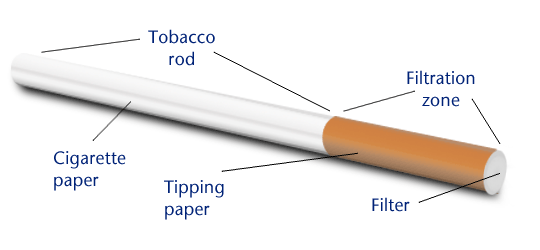
Standard Filter Tip Cigarette


The Rise of Filter-Tip Cigarettes


In response to medical studies on smoking and lung cancer, tobacco firms reinvented their non-filtered brands into filter-tip cigarettes, which looked like ordinary hand-rolled cigarettes, but with a built-in filtration system at the end of each joint. The filter made a cigarette holder unnecessary. Smokers simply held the filtered end between their lips to keep the cigarette steady as they lit up the tobacco-filled tip.

The idea behind putting a filter at the tip of the cigarette was to screen out tar and nicotine, and to make people feel it's "safer" to smoke those types of cigarettes. In 1960s, everybody's all agog about filtered cigs and how they're better than non-filtered commercial smokes, hand-rolled cigarettes, and handmade cigarillos. But, filters had their flaws.

The problem with filters is that they don't actually produce the intended effect of "less." Smokers have a reason for smoking: Their bodies need nicotine. It's a physical addiction. Smokers will inhale the amount of smoke necessary to get the dose of nicotine their bodies need.
Therefore, people who used filtered cigs ended up smoking more cigarettes per day than they did before and spent more money on cigarettes than they used to do.
activated charcoal for air filters
Activated Charcoal


In addition to rolling synthetic fiber sheets into densely packed tubes for the filters, many cigarette manufacturers have also begun using bits of charcoal to improve the air-filtration process. They also believed that the "activated carbon" in charcoal would minimize or remove the unpleasant odors of burnt tobacco and ash from the smoke.

Some cigarettes today boast the inclusion of a "charcoal filter" in addition to the more common dense, synthetic fiber filters seen in almost all filter cigarettes. Manufacturers claim that charcoal filters, which contain bits of charcoal embedded within the fiber filters, reduce certain toxins in the smoke. But no evidence exists that these cigarettes are significantly less dangerous for the user.


new and used cigarette filters
How a Cigarette Filter Works


How Cigarette Filter Tubes Work


Smokers would attach a filter tube to the cigarette's built-in filter. It adds a secondary layer of protection against the presence of TAR and other undesirable particulates in tobacco smoke. The attachment extends the length of the cigarette and serves as the mouthpiece where smokers inhale the refined smoke.

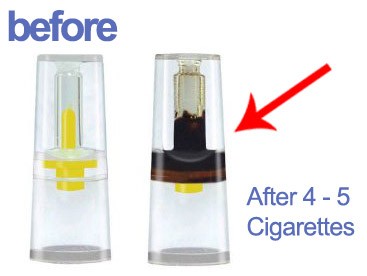
According to this Quora user, the filtration system in these tubes seems to catch more tobacco residue and other chemicals compared to the regular filter in cigarettes. He also said: "After just a few days I notice a significant reduction in my smoker's cough. You can see the tar build up. This permanent filter seems to pull out more than the disposables. It's amazing what the regular filter on a cigarette doesn't get out."

Some tubes have permanent filters, which must be properly disposed as soon as they're covered with dark yellowish stains. Other tubes have reusable tobacco smoke filters, which are washed and dried quickly after every five to ten cigarettes.

Ecigs and Ejuice
E-cigarettes and E-juice Bottles


Are E-cigarettes Better Options Than Cigarette Filters?


Even if you started using disposable filters with filter-tip cigarettes, the tobacco in them would still be full of TAR and other cancer-causing chemicals. Filters don't help in reducing the amount of harmful chemicals in cigarette smoke. More importantly, the continued use of filtered cigarettes or filter tubes only drove smokers to increase the number of cigarettes they consume daily until they've absorbed enough nicotine to satisfy their cravings for the substance.

For someone who'd been smoking for years and would like to gradually wean his or her system from its dependence on nicotine, a full shift to electronic cigarette use is highly recommended. Thousands of ex-smokers have already switched to vaping, which allows them to get their daily dose of nicotine without the rest of those harmful chemicals found in tobacco smoke.

Like these ex-smokers, you'll be using a personal vaporizer - which is very easy to operate, by the way - to convert a few drops of the flavored e-liquid of your choice into pure vapor, which is now rich in nicotine as well as moisture and flavoring particles.

And, that's not even the best part yet.

Vaping gives you control over the total amount of nicotine you'd like to vape each day. Not only do you have a choice which flavors of e-juice to vape all day, you also have the freedom to vape your e-juice with a nicotine strength that works for you.

So, How Do You Make It Work for You?


If you used to smoke two to three packs a day and you just started vaping, then start with a 10 ml bottle of e-liquid that has an 80/20 ratio of PG/VG and a nicotine strength of 24mg/ml. A high amount of propylene glycol will create a throat hit that's similar to the harshness of cigarette smoke.

Meanwhile, a 10 ml bottle with 24mg of nicotine per milliliter of e-liquid means that you have 240mg of nicotine in store. If there were approximately 20 drops of e-liquid in every milliliter, then you'd be getting around 1.2mg of nicotine in every drop. That's 0.2mg more than the average amount of nicotine found in a cigarette.

Gradually change the PG/VG ratio until you have more vegetable glycerin in your e-juice than propylene glycol. At the same, pull down the nicotine level of your e-juice in increments. So, you move on from 24mg/ml to 16mg/ml, and then shift to a low-nicotine strength of 8mg/ml per bottle. Don't be content to vape at a certain level because you may never reach your goal of quitting cigarettes. Do these until you're down to vaping only 3mg to 6mg of nicotine per milliliter.